The Rate
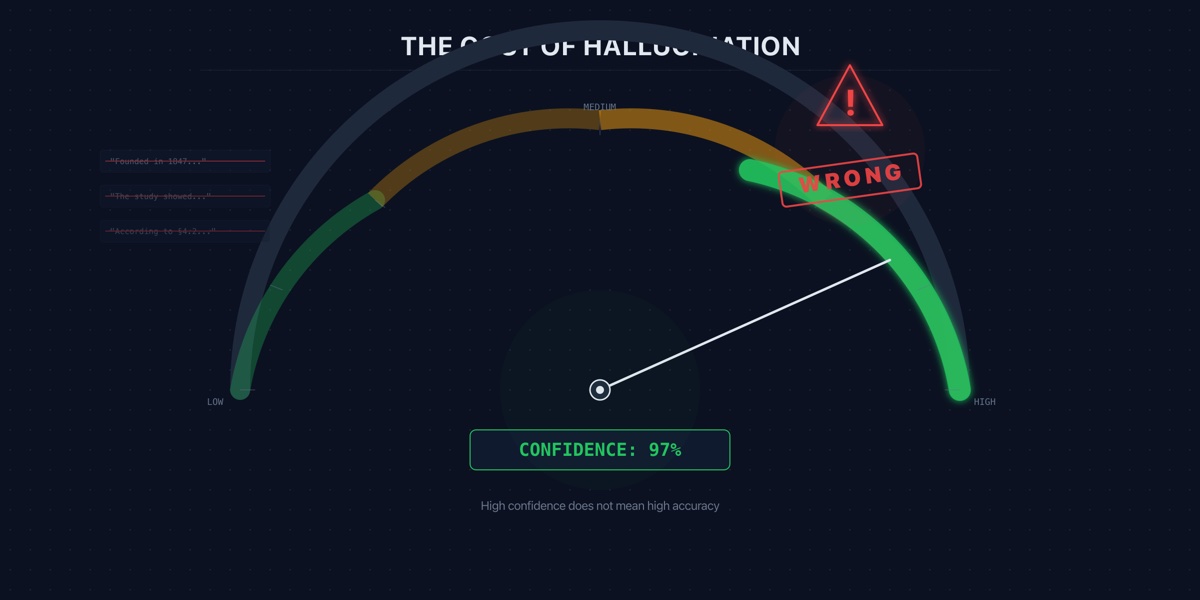
Every LLM hallucinates. The question is not whether your production system will generate fabricated content. It is how often, and what happens when it does.
The Vectara Hallucination Leaderboard provides the most systematic measurement available. Across standardized evaluation tasks, the best-performing models hallucinate at a rate of 1.8%. The worst reach 20.2% [S1]. That is an order-of-magnitude spread across models that are often treated as interchangeable in procurement discussions.
A 1.8% hallucination rate sounds low until you do the arithmetic. A customer-facing system handling 10,000 queries per day at 1.8% produces 180 hallucinated responses daily — 5,400 per month. The model does not flag these outputs. It presents invented facts with the same fluency as grounded ones.
The rate worsens in domain-specific contexts. In legal tasks, hallucination rates reach 18.7% [S1]. Nearly one in five outputs contains fabricated content in the domain where fabricated content carries the highest consequences. This is a structural property of how language models generate text — they optimize for plausibility, not truth. Teams that rely on aggregate benchmark numbers to assess production risk are measuring the wrong thing.
The Cost
Hallucination costs manifest in three categories: legal liability, operational overhead, and reputational damage. All three are measurable. Most organizations measure none of them.
The financial estimates are stark. Industry analysis attributes $67.4 billion in aggregate losses to AI hallucinations, with an average cost of $18,000 per customer service incident involving hallucinated information [S4]. These figures aggregate across industries and should be treated as directional rather than precise — but the order of magnitude is instructive. Hallucination is not a minor quality defect. At scale, it is a material operational cost.
The less visible cost is verification overhead. Employees using LLM-generated content spend an average of 4.3 hours per week verifying AI outputs [S4] — more than 10% of a standard work week. For a team of 50 knowledge workers at $75 per hour, the annual verification cost exceeds $800,000. If verification costs exceed the productivity gains from LLM adoption, the deployment is net-negative. Few organizations track this metric.
The Cases
Two legal cases established the precedent that matters for production teams.
In Mata v. Avianca, attorney Steven Schwartz submitted a legal brief to a federal court containing six case citations generated by ChatGPT. None of the cases existed. The fabricated citations included plausible case names, realistic docket numbers, and invented judicial reasoning. The attorney was fined $5,000, and the case became the first widely reported instance of LLM-fabricated legal citations reaching a court proceeding [S2].
The fine was modest. The precedent was not. Responsibility for verifying AI-generated content rests entirely with the human who submits it. The model provider bears no liability.
The Air Canada chatbot case extended this principle to automated systems. Air Canada’s chatbot told a customer that bereavement fare discounts could be applied retroactively. The actual policy did not permit this. The Civil Resolution Tribunal ordered Air Canada to pay $812 in damages [S3].
Air Canada argued that the chatbot was a separate entity and that the company could not be held responsible for its statements. The tribunal rejected this argument, ruling that Air Canada was responsible for all information on its website, whether provided by a static page or a chatbot [S3]. The implication is clear: deploying an LLM-powered interface does not create a liability shield. If the model says it, the company owns it.
These cases involved small sums. As LLM-powered systems are deployed in insurance claims, medical triage, and financial advisory, the cost of a single hallucinated output scales with the value of the decision it informs.
The Citation Problem
Beyond factual hallucination, there is a specific failure mode that deserves separate attention: fabricated citations.
A Columbia Journalism Review evaluation of AI-powered search tools found that ChatGPT Search produced incorrect citations 67% of the time when referencing news sources. Grok performed worse, producing incorrect citations 94% of the time [S5]. These are not edge cases from adversarial prompting. These are standard information retrieval queries where the system confidently returned fabricated or misattributed sources.
For any application where the output includes references — legal research, academic writing, journalism, regulatory filings — the citation fabrication rate is the metric that matters, not the overall hallucination rate. A system that generates plausible-sounding text with fabricated supporting citations is more dangerous than one that is obviously wrong, because the citations create a false sense of verification.
Detection Methods
Detecting hallucination in production is harder than detecting it in evaluation. In evaluation, you have ground truth. In production, you often do not — which is precisely why the model was deployed in the first place.
The most promising approach for production deployment is consistency-based detection. SelfCheckGPT samples multiple responses to the same prompt and measures agreement across samples. Factual statements the model has genuinely learned will be consistent across samples, while hallucinated content will vary [S6].
SelfCheckGPT achieved a 78.32 Pearson correlation with human judgment for hallucination detection, without requiring any external knowledge base or ground truth [S6]. Hallucination detection can be deployed as a post-processing layer that operates on the model’s own outputs alone.
The limitation is latency. Sampling multiple responses multiplies inference cost. The practical implementation is to run consistency checks asynchronously on a sample of production traffic and flag high-variance outputs for human review.
Other approaches include retrieval-based verification — comparing claims against a trusted knowledge base — and classifier-based detection. Each adds infrastructure complexity. But so does deploying a system that hallucinates at measurable rates without any detection mechanism at all.
Mitigation Strategies
Hallucination cannot be eliminated. It can be managed. The mitigation strategy should be proportional to the cost of a hallucinated output in your specific domain.
Retrieval grounding. RAG reduces hallucination by constraining generation to retrieved evidence. This is the single highest-impact mitigation for knowledge-intensive applications. The rate does not go to zero — the model can still misinterpret or extrapolate beyond retrieved content — but it drops meaningfully.
Output structure constraints. Forcing structured output formats — JSON schemas, enumerated fields, constrained generation — reduces the surface area for hallucination. A model asked to extract a date from a document into a date field has less room to fabricate than one asked to write a free-form summary. Where your use case permits structured output, use it.
Human-in-the-loop for high-stakes outputs. For legal, medical, and financial applications where a single hallucinated output can create material liability, human review is not a workaround — it is a system requirement. The design question is not whether to include human review, but where in the pipeline to place it and what percentage of outputs to route through it.
Monitoring and measurement. Track hallucination rates as a first-class production metric. Sample production outputs, have them evaluated against ground truth or by human reviewers, and measure the rate over time. If you cannot measure your hallucination rate, you cannot manage it — and you cannot assess whether your mitigation investments are working.
The gap between the best-case 1.8% and worst-case 20.2% on standardized benchmarks [S1] means that model selection alone can reduce hallucination risk substantially. But model selection is the beginning of the mitigation strategy, not the end. The organizations that treat hallucination as an operational risk — with measurement, detection, and mitigation commensurate to the stakes — will be the ones that avoid becoming the next case study.